Law & Politics
The First Time I Saw Democracy Work
Watching my Republican friend vote, and why the label is the ballot.
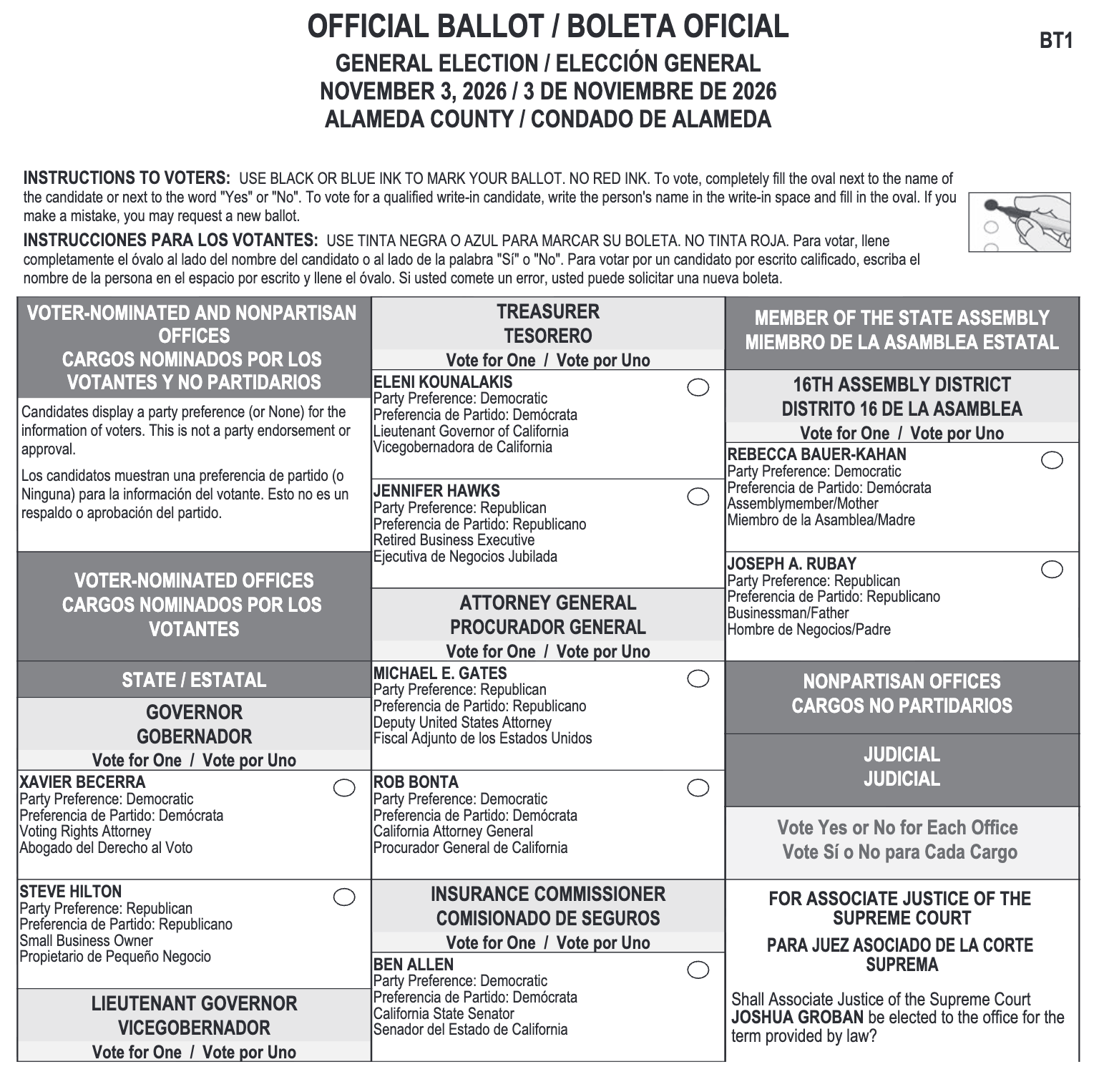
A few nights before the election, I watched my friend fill out his ballot. He is a Republican, a citizen, and, as I learned that night, the most honest voter I know. The party had mailed him a small slate mailer: yes on these propositions, no on those. He copied it straight down. Every Democrat-versus-Republican race went to the Republican, including names he had never heard of. When two Democrats ran for the same seat, he looked at the endorsements instead. When he saw that Bernie Sanders had endorsed one of them, he promptly voted for the other. And when an incumbent's name came up with no scandal attached, he shrugged: let him stay.
Looking back, that one evening showed me three behaviors: the party label, the endorsement, and the incumbent. My friend reads no campaign news and follows no scandals, yet he finished the long ballot in minutes.
The Ballot Is Too Long to Read
The first reason is the length of the ballot itself. California runs a plural executive: the governor, the lieutenant governor, the attorney general, the secretary of state, the treasurer, the controller, the insurance commissioner, and four tax-board members are each elected separately, each with an independent mandate. The governor cannot fire a single one of them. Every one of them needs its own line on your ballot. That is before the judges, the sheriff, the school boards, and the water boards. This is not a California disease either: Texas, Washington, and Utah all elect their executives piecemeal, and the fragmentation just lands in different places.
What surprised me is that the most boring names on the ballot often control the most money. Here are a few examples:
The Railroad Commission in Texas. It has regulated no railroads since 2005. It regulates oil and gas drilling permits, pipelines, and flaring across a state producing nearly half the nation's crude, which means it holds no fund but controls who gets to make money. This year Bo French ousted the incumbent Jim Wright in a primary runoff by half a point, and November voters will pick an oil czar thinking they are picking a train manager.
The Land Commissioner in Texas. Thirteen million acres of public land, plus the spigot of the Permanent School Fund, on the order of $50 billion, flowing into school districts, plus billions in federal disaster money, plus the Alamo, the old Spanish mission where Texas rebels made their last stand against Mexico in 1836. For an office with such a plain name, it manages a remarkable amount of public money.
The Lands Commissioner in Washington. The mirror image, except the crop is trees. It manages five million acres of state trust land, where timber is sold to build K-12 schools. Texas funds its classrooms with crude oil and Washington funds them with lumber, so the two offices are the same job with different forests.
The Insurance Commissioner in California. No fund at all, but something sharper: prior approval over auto and home insurance rates, which means one signature can move every family's premium in the state.
The Justices in California. Even the judges are on the ballot: trial judges face nonpartisan election, while supreme court justices get a yes-or-no retention vote every twelve years.
To complete the picture, the Agriculture Commissioner (school lunches, honest gas-station scales) is the control group: proof that some boring names are honestly minor. And the Texas State Board of Education, fifteen elected fund managers for that $50 billion who also vote on what goes in the textbooks, is the most expensive single letter on any American ballot: one R buys you a fund manager and a censor at once.
The pattern I see is that the more money a down-ballot office controls, the fewer voters know its name, and the fewer who know, the more the letter decides.
There Is No Universal Ballot
The second thing I learned is that your ballot is not the ballot. Congressional districts, state legislative districts, county, city council, school, water, and transit boards each draw their own maps, and your address sits under a dozen of them at once. Every unique stack is a ballot style. The street across from yours can vote for a different council member; two streets over, the school board changes; live in an unincorporated patch and the entire city-council column vanishes. A large county prints hundreds of versions. The top of the ticket looks the same for every voter in California. The governor, the statewide offices, and the state propositions do not change with your address. Everything below that is where the versions split. Flip through Alameda County's official guide below and you can see both halves in one place, the statewide top and the local rest.
One more thing I noticed while flipping through the guide. Both candidates for governor left their statement blank, while almost every down-ballot candidate wrote one. Later I learned that statement in the state guide costs $25 per word, up to $6,250, and it is entirely optional. The two frontrunners are famous enough that 250 words buy them nothing, and every sentence on record becomes attack ad material. So the one neutral document mailed to every voter ends up emptiest exactly where the stakes are highest.
My friend's slate mailer reflects the same split. Its proposition recommendations are identical statewide, while the candidate side has to be targeted by district, since his assembly member and his council member are not yours. That is also why the party letter and the endorser's name carry such weight: they are the only language spoken across all hundred versions. When two Democrats share a column and the letter goes silent, as in Allen versus Kim, the voter reaches for the next signal down: who vouches for whom. My friend seeing Bernie's name and voting the other way was not cynicism, just cue-taking with the sign flipped.
Nobody Runs It
The fragmentation runs all the way down to execution. The secretary of state writes the rules and certifies the results, but the ballots are built and printed by 58 counties, each on its own systems, each outsourcing to private vendors. The state can audit a county; it cannot take the election out of its hands. Every November some county somewhere has a bad night on camera, and the structure makes it likely to happen again.
The same fragmentation divides the governments themselves. The county is the state's arm: it runs the elections, the jails, the courts, and the welfare office on the state's behalf. The city is a self-governing corporation chartered under state law. It answers to its own council, not to the county, though the state can preempt it whenever it wishes. And the two are not stacked: you are either a dual resident of both, or, in the unincorporated patches, a resident of the county alone, with no mayor and no council column on your ballot. When one voter lives under three turfs, every failure comes with three addresses to blame, and the voter, unable to referee, goes back to the letter.
The Last Mile Is a Signature
What struck me at the end of the night was how thin the whole ritual is. My friend signed the envelope, sealed it, and that was it. Later I learned that by law every signature is checked against the one on the registration record, software first, humans second. Signatures that do not match get flagged, and the voter gets weeks after Election Day to fix it with a sworn statement. Fewer than one in a hundred ballots die this way.
What I kept thinking about is what that check actually proves, which is only that the envelope is yours. It proves nothing about who filled in the ovals, and California lets anyone hand in anyone else's ballot. At first this looked naive to me, until I did the arithmetic: forging one signature buys one vote at the price of a felony, and retail fraud does not scale.
Voting in person looked even thinner to me. At an Alameda County vote center you give your name, sign a screen, and receive the ballot style for your address. No ID is required, Chinese ballots are available on request, and same-day registration is offered at the door. I found myself torn the way the whole state is torn, since this is the entire voter ID war in miniature: a driver's license feels trivial until you are one of the millions without one, and in a state where licenses do not prove citizenship anyway, each side's common sense looks like cheating to the other. Either way, by the time my friend's signature dried, the election was already decided, back on the night the slate mailer arrived.
The Cheat Sheet Is Rational
Back to my friend and the three behaviors I saw that evening, which I do not see as failures of citizenship. They are one marketing machine with three floors, the same machine I once described in The Tiny Designs That Keep You Scrolling:
The letter is the brand. Republicans and Democrats are the Coca-Cola and Pepsi of politics, a century of advertising spend compressed into one letter. My friend voting straight R is the same motion as grabbing Colgate without reading the toothpaste reviews, since the candidate is the SKU and the party is the equity.
The endorsement is the influencer. Bernie vouches and his followers buy the SKU, while my friend sees the post and buys the rival, so a diss post moves votes much like a sales post. The slate mailer itself is the livestream shopping list: yes on this one, no on that one, family, just click in. What converts voters is the person, not the pitch, since nobody read Allen's or Kim's platform while everybody recognized Bernie's name.
The incumbent is the familiar face. Psychology calls it the mere exposure effect: around the fifth sighting, familiarity starts feeling like trust. Four years of ribbon-cuttings and free press buy what a challenger must purchase with millions. "Haven't heard anything bad, let him stay" is just retrospective voting: the burden of proof sits on the challenger, and the proof usually required is a scandal like the Santa Rita jail deaths that ended a sixteen-year sheriff in this very county.
I am not a citizen yet, so that night I only watched. But I started a list for the day I get to vote myself. Read the money line first: who controls which fund, and where it flows. Ask who can fire whom: an independent office cannot be fixed by voting for a different governor. Treat every endorsement as information about the endorser, not the candidate. And flip my own incumbent default from "I have heard nothing bad" to "I have heard something good."
My friend finished his ballot in minutes. I suspect my first one will take me a week. For a first time, that seems about right.