Law & Politics
Five Shades of Red
Five Senate seats, five kinds of Republican country, and what the 2026 midterms will decide in each.
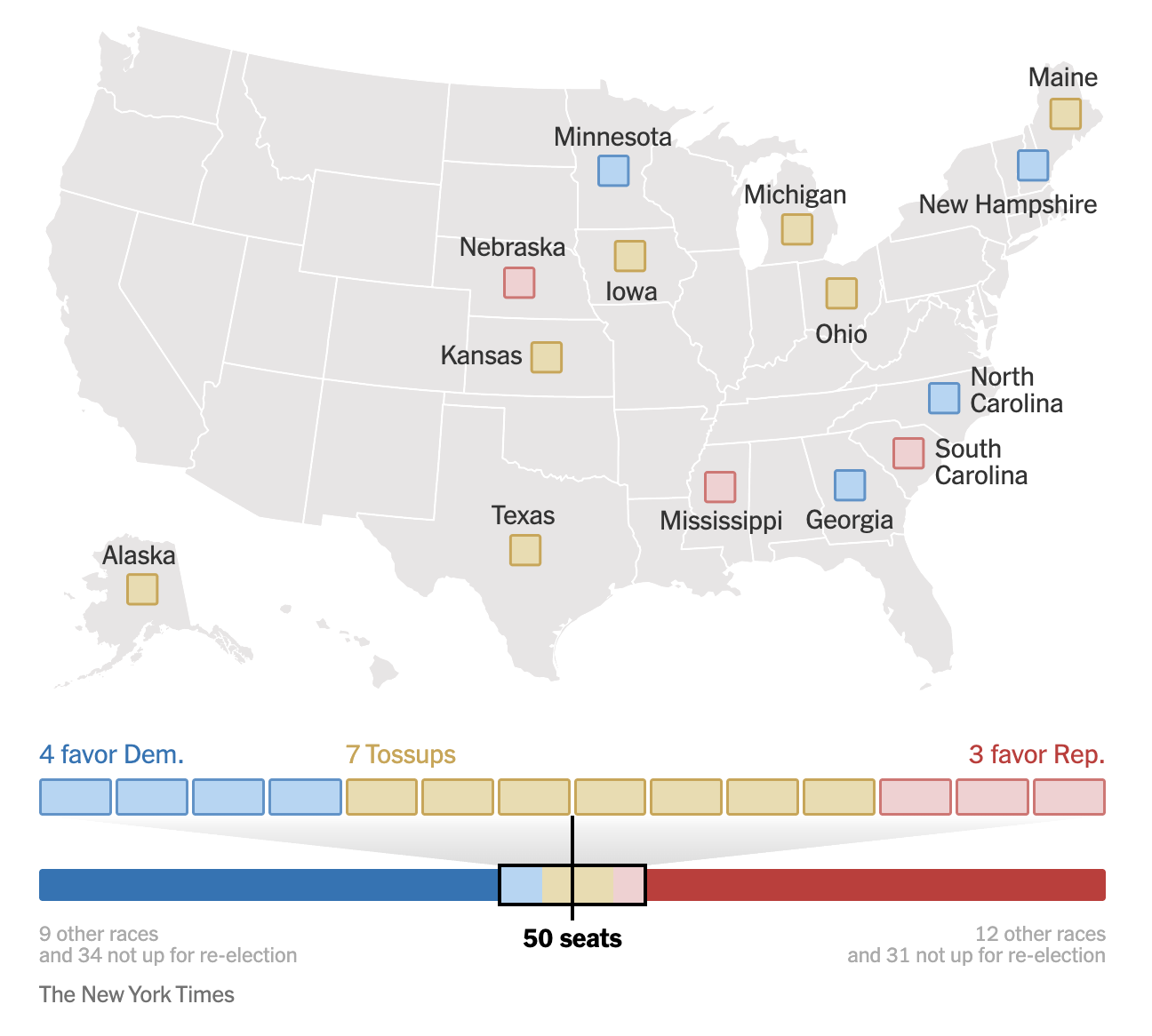
The midterms are weeks away, and the Senate map holds an unusual sight: Texas, Alaska, Ohio, Iowa, and Maine, every one of them carried by Trump, every one of them rated competitive. Midterm drama is supposed to belong to a handful of swing states while solid red and blue states sleep through it. This year the red states woke up. Look closer and they are not red in the same way. Each is competitive for its own reason, and each reason is a different kind of red.
Texas: Private Oil and Tejano Conservatism
Every senator's vote counts the same. Seats don't. Texas should be free for Republicans; having to defend it is itself the emergency. Money spent in Houston and Dallas–Fort Worth can't be spent in Ohio or Georgia. Worse, the seat is a MAGA-versus-establishment verdict: Ken Paxton's camp against John Cornyn's. If Paxton loses a seat Cornyn would have held, the establishment gets to say the party was warned.
Paxton's record is a decade of lawsuits: 100-plus against the Biden administration, a $1.4 billion privacy settlement from Meta, $1.375 billion from Google, a Supreme Court win upholding Texas's age-verification law. His scandals are the same coin: the 2015 securities indictment, the 2023 impeachment and the bribery allegations look like persecution to supporters and corruption to everyone else. The half that votes for him is mostly casting vetoes against a Democratic Senate, not endorsements of the man. Scandals cost roughly 2 to 5 points, invisible at R+15 and fatal at R+5. Texas is now R+5.
The Democrat, James Talarico, is running a de-Beto campaign. Beto ran for Senate only once, losing to Ted Cruz by 2.6 points in 2018, then a presidential bid, then a double-digit governor loss, and the "hell yes, we're taking your AR-15" line replayed in every Republican ad since. Talarico is a former schoolteacher and seminary student running on public schools, anti-voucher populism, and corruption, local issues he can preach in rural churches Beto could never enter. And he faces the scandal-ridden Paxton, not the disciplined Cruz. Polls have him narrowly ahead.
Texas invites two comparisons that each break a lazy theory. California has the same ~40% Latino share, but Proposition 187 in 1994 pushed its Latinos into the Democratic column for a generation, while the Texas GOP under Bush and Rove courted theirs. Texas Latinos, heavily multi-generation Tejano and culturally conservative, vote only ~55–60% Democratic, and the border counties have been drifting red. New Mexico breaks the theory from the other side: oil, border, 47% Latino, yet blue, because its Hispanos carry a New Deal Democratic tradition, its whites (Los Alamos scientists, Santa Fe professionals) split evenly, and one blue metro dominates a tiny state. Demographics is possibility; history is destiny.
The real template is Georgia: a growing blue metro, defecting suburbs, and a Black-organizing machine. Texas has one and a half of the three. The metros are growing, but the suburbs (Collin, Denton) are still red, and nothing matches the Abrams machine. Talarico's bet is that a rotten opponent plus one more suburban shift can run the formula early. What's on the ballot is not one seat but a belief: Texas can be won. Beliefs, once proven, build machines that outlive any single race.
Alaska: Public Oil and Native Sovereignty
Alaska's map defies the mainland rule that cities are blue and countryside red. In 2024, Anchorage went for Harris by just 1.4 points, while remote Bethel, Kusilvak, and Yukon–Koyukuk went bluer by 13 to 22 points. The variable is Alaska Native share: Kusilvak is 97% Native, Bethel 89%. Strip that out and rural Alaska snaps back to deep red: white Mat-Su went for Trump by nearly 50 points. The Democratic coalition is "blue at both ends, red in the middle": Anchorage liberals plus Yup'ik, Inupiat, and Athabascan villages reachable only by small plane.
This is not a resource state turning blue. Oil doesn't dictate color. New Mexico pumps oil but still votes blue. In Texas, oil wealth flows to private firms, so the industry demands low taxes and light regulation, which is Republican politics by another name. What matters is how the money flows: Alaska's royalties feed the Permanent Fund, whose dividends go straight to residents, so pro-oil, pro-union, and pro-spending coexist without contradiction. Add a fishery logic no left-right axis captures (drill, but don't let trawlers kill the salmon) and the federal paradox: Washington, don't tell me how to hunt, and don't you dare cut the $13 billion. Alaska is red because of guns, federal land resentment, the military, and white rural counties, not because of oil as such.
What makes it flippable is elasticity. 59% of registered voters are undeclared or nonpartisan. The top-four primary plus ranked-choice voting lets moderates survive without a partisan primary. And Lisa Murkowski's 2010 write-in win proved loyalty runs to the person. Her name wasn't even on the ballot, and this was years before RCV existed. This year the Democrats fielded the best-fit candidate imaginable in Mary Peltola, a Native, pro-Willow, "Fish, Family, Freedom" candidate. She led Dan Sullivan in the August top-four primary. The most candidate-elastic red state meets the most Alaska-shaped Democrat. That's the whole race.
Ohio and Iowa: The Balanced Red
A decade ago both were swing states; Obama won Iowa twice. Then the white working-class realignment painted them red, and Trump took Iowa by 13 points in 2024. Ohio's three big cities (Columbus, Cincinnati, Cleveland) drown in a larger rural sea; Iowa's small towns just flipped.
What's loosening them is this year's pileup, not a reversal of the trend. Both have open seats. Governor Reynolds isn't running again, Senator Ernst retired, and open seats flip easiest. Farm states feel tariffs first: an estimated $1,745 per household this year, plus soybean and pork exports under pressure. And Democrats already showed life, winning four of six Iowa legislative specials with 20-plus-point overperformances. The numbers: Rob Sand leads the governor's race 49–45, the Senate race sits at 47–45, and Cook moved the Senate seat to toss-up and the governorship to Lean D.
The pair differs in volatility. Ohio is structurally redder: its rural mass absorbs urban blue. Iowa has 3 million people: Des Moines suburbs plus two college towns plus a few river counties, moving together, can flip the state. Small states tip; big states grind.
Maine: Liberal Republicans
Susan Collins looks impossible only if you miss the lineage: Margaret Chase Smith → William Cohen → Olympia Snowe → Collins, an unbroken moderate-Republican bloodline stretching back to the woman who stood up to McCarthy. Collins built her brand before polarization, and Maine voters learned long ago that Maine Republican ≠ national Republican. RCV arrived in 2018; it didn't create her.
The neighbors sharpen the point. Vermont elects a pro-choice, Harris-voting Republican governor with 73%, yet would never send a Republican to Washington, where the national label sticks. New Hampshire runs libertarian Republicans for governor while splitting tickets federally. Progressive Yankee, libertarian Yankee, independent Yankee: three tribes, one old dislike of being told what to think. Only Maine stayed red enough downstate, and moderate enough upstate, to keep a 1990s Republican in the Senate to this day. This November tests whether a thirty-year-old formula still clears 50%.
The Five Reds
In a nutshell: Texas is red on Tejano conservatism, a vast rural sea, and privately owned oil that wants low taxes and light regulation. Alaska pairs light-blue Anchorage with deep-blue Native villages and publicly owned oil that pays every resident a dividend, a red state unusually fond of government spending. Ohio and Iowa are the balanced red, where urban blue and rural red weigh close enough that tariffs and turnout can tip the state. New England Republicans are liberals who can win the statehouse but almost never Washington, and Maine is the exception that kept one 1990s Republican in the Senate.
What Actually Decides
Stepping back, none of these races turned on what observers usually cite. Demographics alone explain nothing: Texas and California share a Latino share and opposite colors, and the Blackest state in the union (Mississippi, where whites vote almost 90% Republican, versus about two-thirds in Georgia and a coin flip in California) is among the reddest. Industry explains just as little: oil country can be Texas red, New Mexico blue, or Alaska elastic. Four things matter more.
First, where the money comes from: private oil demands deregulation, public oil pays dividends, and a laboratory town votes differently from a base town. The same logic travels: Nevada runs on casino-union money and muscle, Northern Virginia on federal paychecks, and West Virginia turned red when Democrats became the anti-coal party.
Second, which way the people are moving rather than how they are stacked today: growing metros and shifting suburbs turned Georgia, Virginia, Colorado, and Arizona blue or purple, and now threaten Texas, while Florida grew just as fast in the opposite direction, fed by conservative retirees and Cuban and Venezuelan arrivals. Stagnant states stay put.
Third, the rules that turn residents into voters: who gets registered, who gets purged or disenfranchised, and whether the ballot lets moderates survive.
Fourth, cutting across all three above, culture and faith: Mississippi is poor and runs on federal dollars, yet votes deep red, because evangelical and racial identity outweigh the money. Levels deceive; flows decide, except where faith decides first.